Strategic Enrollment Management and Marketing Conference Recap: What We Heard (and What It Means)
It took me a bit longer to SEMM conference this than I had hoped – life happens sometimes (and now you know I write these posts, not AI). We'll return to our data governance series next post.
Earlier this month, I attended my first Strategic Enrollment Management and Marketing conference in Hamilton, Canada. Like most good conferences, some of the most interesting parts were conversations among attendees and themes that emerged across different sessions.
One thing that hit me by the first coffee break (before the jet lag from the red eye hit me) was the diversity of attendees. The conference brought together a healthy mix of professionals: from enrolment, SEM, recruitment, registration, and marketing to institutional analytics teams, deans, and even professors. The thread that united them was a shared goal: supporting learners in their success, and being more intentional about how to do that.
Here’s my top 5 themes from the conference:
1. AI Was Everywhere, But Experience Varies
AI was the elephant in the room. It was visible, but not everyone had the same experiences.
AI was the elephant in the room. Visible - but not fully agreed upon.
I saw a spectrum of:
- excitement
- skepticism
- fear (especially around roles in admissions, records, etc.)
- and some very real, operational use cases
What I saw was that everyone was aware of AI, most were using it daily, but few institutions had gotten to the point of consistent and intentional usage coupled with upskilling teams and appropriate guardrails and security.
Many mentioned challenges with systems not communicating with each other, and data definitions being poorly understood.
AI opens up a world of possibilities for better integrating data, but our research with CIOs and identity and access management professionals earlier this year is a good reminder that AI can get you more wrong answers, faster, without strong data governance.
Want to learn more about how live data governance can help your institution? Check out our webinar recording
The most compelling operational example I saw came from a college that had rethought their entire student inquiry model from the ground up - more on that in a moment.
The through-line across sessions: AI removes the repetitive work so staff can actually help students.
2. The Student Experience Is Still Fragmented
That example was Okanagan College - and what made it stick wasn't the AI. It was what drove them to build it in the first place.
As part of their journey in Strategic Enrolment Management, one thing that stuck out was that the experience for students had become fragmented. Whether intentional or not, students were left to figure out the college’s internal structures in order to solve problems.
The result was that students would call or email from among dozens and dozens of contacts, often repeating the same question in all these places (it turns out OC had over 300 departmental email addresses and 30+ phone numbers on their site). This resulted in a poor experience for students and prospects.
Further, the college had no ability to track these requests, which meant there was no effective way to improve the service to students because no one knew the scale of the problem or even what kinds of questions came up.
Okanagan decided to simplify this process for students with the concept of a single “front door” for student inquiries:
- one phone number
- one digital entry point (“Ask OC”)
- a CRM and knowledge base underneath
Their AI layer searches a curated knowledge base and provides real-time, vetted answers. When it can’t answer, it escalates to a human from the OC Experience team who can escalate further if needed.
In its early iterations, around 30% of questions were handled by the system. Now it’s closer to 90%.
Just imagine how much staff time that frees up to provide actual service for students rather than rehashing previous answers.
Despite that high percentage, their experience shows how AI doesn't and can't replace staff, but instead supports their work in helping students.
What Okanagan College showed is AI wasn’t the key element to helping students navigate their system and services, but it helped enable several important aspects:
- Making it so any question could be asked and responded to quickly, using a centralized intake process and knowledge bases to ensure accuracy.
- Encouraging the college to fully document the student journey, where friction exists, who is responsible for which parts, where handoffs occur, and ultimately who is accountable at each step.
- Increasing visibility into the kinds of requests students have, and enabling improvements so they can be served faster.
and only then layering AI on top to help them move faster
Or put another way, AI is a flashlight, not a replacement (from the presentation).
The part that really stood out here is how sincerely it was motivated by the student journey.
3. Growth Is Still Happening (Even If the Narrative Says Otherwise)
If you’ve been following the news or Ken Steele’s trackers, you’d think the entire sector of higher education is in decline (which it is, admittedly).
But there are still pockets where growth is happening.
Northern Lights College shared a story of significant domestic growth:
- ~32% increase over two years
- strong growth in Indigenous enrolment
- applications up again heading into Fall 2026
All of this in a region where:
- Labour market competition is strong (oil & gas) and often competes directly with the college
- Degree attainment is significantly below the provincial average
- The target population for recruitment is less concentrated and geographically dispersed across a large area than more urban college districts
One of the big changes implemented at NLC was the concept of “No Seat Left Behind”, or “Enrolmentmaxxing”, as described by Scott Clerk, AVP of Educational Services at NLC.
In highly constrained programs (like trades), even one empty seat matters. In trades and vocational programs, an empty seat carries forward a full two years. Filling that seat materially improves sustainability.
Instead of accepting attrition, Northern Lights College actively backfills:
- Pulling from waitlists
- Offering early starts to future admits
- Adjusting timelines to create space to react
Small changes like these add up to big gains over time.
4. Everyone Wants to Move from Requests to Insights
Across roles (registrars, IR, marketing, leadership) there was a shared desire for strategic use of information:
“We want our teams finding insights and supporting decisions, not just responding to requests.”
But almost everyone admitted they’re still stuck in the request cycle.
Why?
Because:
- Data is hard to access across systems
- Definitions aren’t consistent
- Numbers don’t match
- Trust is fragile
So instead of analysis, teams spend their time reconciling.
Perhaps you’re following my series on modern data governance - we talk a lot about these challenges, including in our recent webinar (the recording and slides are now available here).
These challenges can be addressed, but it takes collaborative investment and intentional efforts that cross departmental and operational divides.
5. There’s Cautious Optimism About What Comes Next
Despite the uncertainty - especially around international enrolment - there was a sense that things may begin to stabilize in the year ahead.
With Canada’s reporting the biggest population decline on record (Apple News | Globe and Mail), there is a view that we’ll start to see more consistency and predictability on visa processing for the smaller and more intentionally selected international student population Canada desires.
If visa processing becomes more predictable and timelines improve, institutions may be able to plan with more confidence again.
Most attendees acknowledge that the future will not be the unmitigated optimism and unparalleled growth in international enrolments in the decade spanning 2014/15 to 2023/24. In that time period, international enrolments nearly tripled (217k to 573k), while college international enrolments nearly quintupled (58k to 288k) (Statistics Canada).
This means planning will have to look a little different. They know it will need to be more cautious with unbridled growth assumptions, and that we’ll have to intentionally plan where international enrolments will help Canada’s broader economy, which means much more planning around how programs can impact the job market, consultations with businesses, and alignment for how programs are classified in relation to labour force needs.
But it also means that postsecondary education in this country needs to be better funded and not only by international tuition.
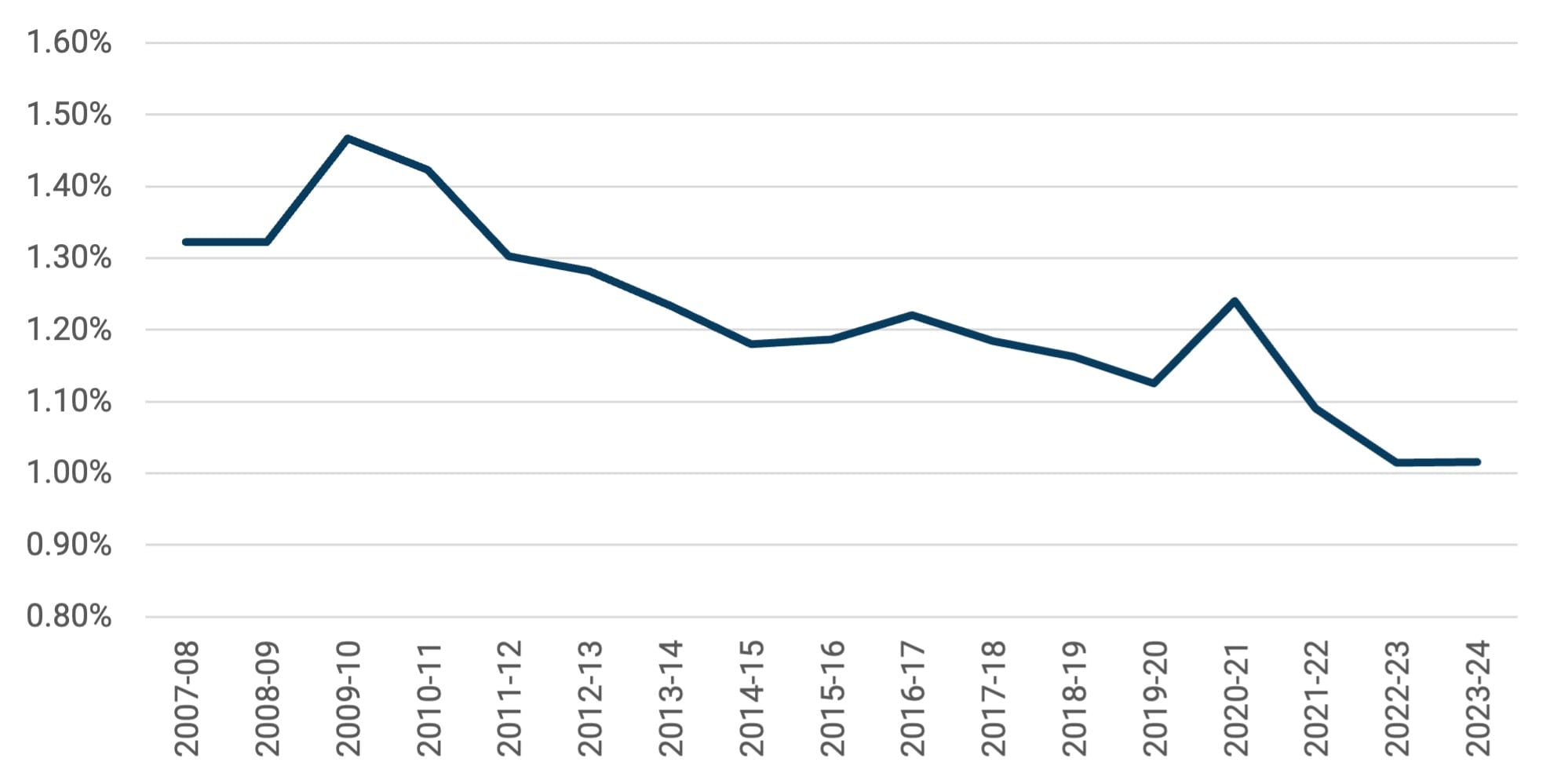
As many of you know, public spending on postsecondary education as a percentage of GDP in Canada has been declining for more than a decade, as you may have seen in Alex Usher, Jiwoo Jeon, and Janet Balfour's excellent report The State of Postsecondary Education in Canada, 2025 (HESA is our partner). Here I’ll reproduce a couple graphs from their overview to illustrate.
💡Recommended Reading: The State of Postsecondary Education in Canada, 2025
An annual benchmark report on funding, enrolment, and the financial trajectory of Canadian postsecondary education. The 2025 edition documents how public investment has declined relative to GDP, population, and government spending over the past 15 years - and what that means for the sector's long-term sustainability.
Usher, A., Balfour, J. & Jeon, J. (2025). The State of Postsecondary Education in Canada, 2025. Toronto: Higher Education Strategy Associates.
Figure 3 (HESA): Public Spending on Postsecondary Education as a Percentage of GDP, in $2023, 2007-08 to 2023-24
Reproduced from: https://higheredstrategy.com/the-state-of-postsecondary-education-in-canada-2025/
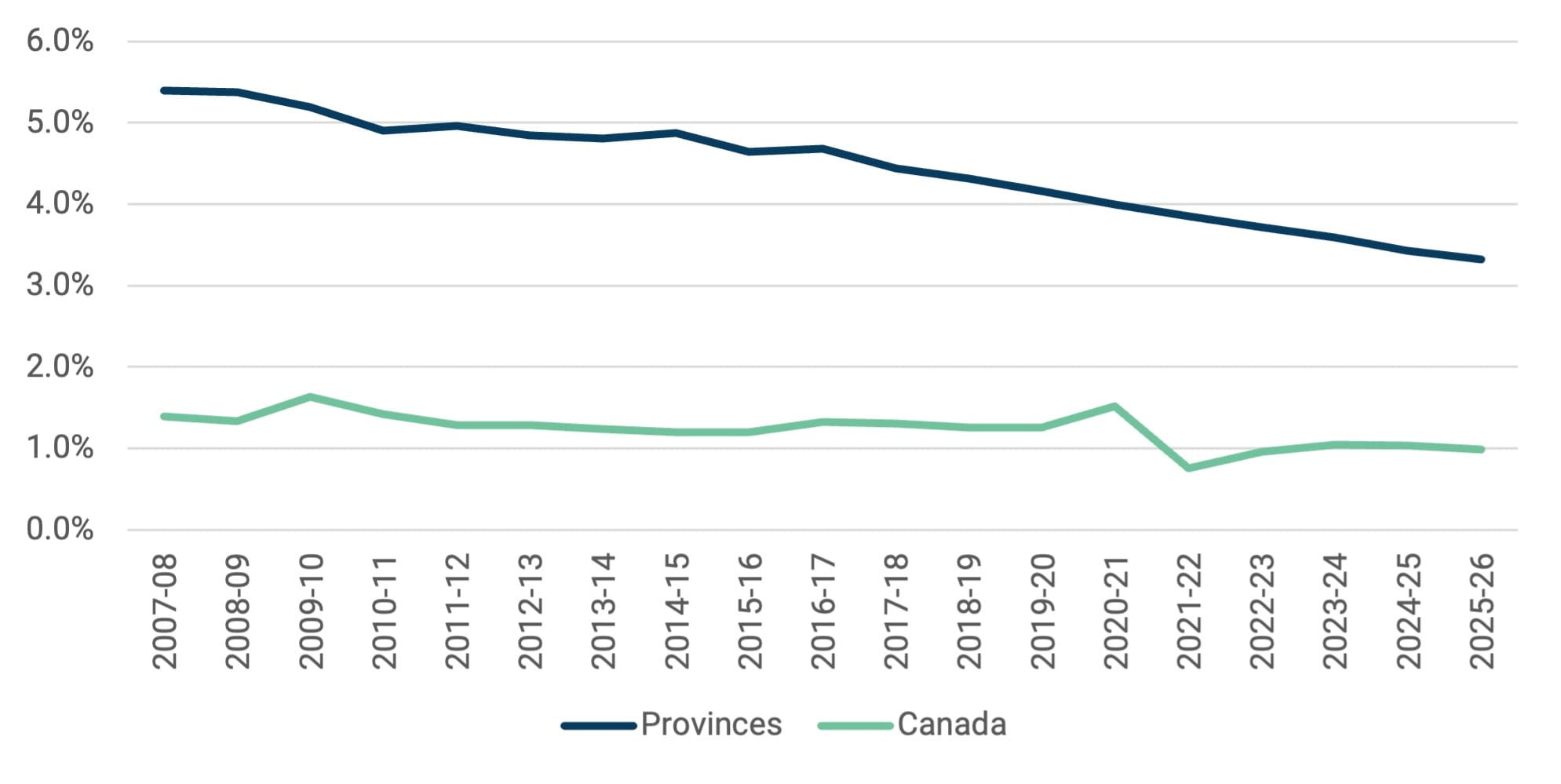
Lest you think GDP is a useless comparator, if we look at percentage of government spending, the same holds.
Figure 5 (HESA): Public Spending on Postsecondary Education Institutions as a Percentage of Total Government Spending, Federal and Provincial Governments, in $2023, 2007-08 to 2023-24
Reproduced from: https://higheredstrategy.com/the-state-of-postsecondary-education-in-canada-2025/
There are many ways that education could be better funded:
- A rise in domestic tuition as Alex Usher notes
- Investments by provincial governments, such as the recent Ontario announcement
- Changing mixes of programs, particularly shorter-term career-relevant programs, as advocated by Ken Steele
- Finding efficiencies and cost cutting (I’d argue with 20,000 roles eliminated, institutions have done their part of this for a bit).
- Larger focus on attracting and retaining underserved domestic populations (see the example from Northern Lights College, above).
- Increased focus on non-tuition revenue streams – hosting conferences, renting facilities, etc.
The upshot here is that a little bit of stability will allow institutions to do better planning, even if ultimately the numbers they have to work with are lower than they hoped.
Predictability matters a lot: for prospective students choosing a country or institution, for resource planning, and for anyone trying to model what three years from now looks like.
The last decade taught institutions a hard lesson: unbridled optimism about international enrolment wasn't just a strategy, it was a bet - one that, to be fair, was actively encouraged by federal and provincial policy at the time. When the signals changed, institutions that had built their budgets around continued growth had very little room to maneuver.
The cautious optimism at SEMM didn't feel like denial of that reality.
It felt like a sector that has genuinely internalized the changes, one that is now asking better questions about what sustainable, intentional enrolment planning actually looks like.
What This Means
Stepping back, a few themes cut across everything we heard - and they point in a consistent direction for the sector.
- AI is moving from concept to operations. The question is no longer if institutions will use AI, but where it adds value and how to implement it responsibly.
- Student experience is a systems problem. Fragmentation isn’t just a communications issue: it’s a design issue spanning people, processes, and platforms.
- Growth is uncommon, but there are exceptions. Headlines don’t tell the whole story. Institutions that align strategy with their context are still finding ways to grow.
- Operational discipline matters. Small process changes (like filling a single seat) can compound into meaningful outcomes over time.
- Insight is constrained by foundations. Teams want to do higher-value work, but inconsistent data, definitions, and access keep them stuck in reactive modes.
- And ultimately, data problems are organizational problems. Governance, coordination, and shared understanding matter as much as technology.
Taken together, this suggests a shift in how institutions need to think about enrolment and strategy:
Not just setting better plans - but building the systems, data, and alignment required to execute them.
This is likely the start of a few deeper dives in the coming weeks.
For now, I’d love to hear:
- What are you seeing in your institution right now?
- Do these themes resonate, or is your experience different?