
Reporting with Confidence: Data Lineage for Outcomes & Performance Funding (Webinar Recap)
Thanks to everyone who joined us for our recent webinar, Reporting with Confidence: Data Lineage for Outcomes & Performance Funding.
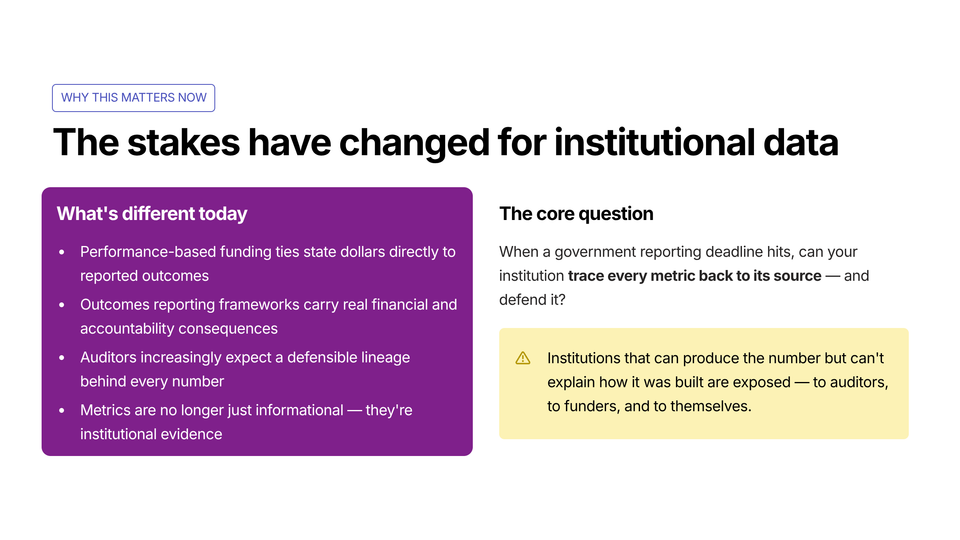
This session focused on a challenge many colleges and universities know well: the number may be published, but the logic behind it is often much harder to explain. When outcomes reporting influences funding, accountability, and audit exposure, that gap becomes a real risk.
Here's everything from the session in one place.
📋 Resources
- Recording: Watch the recording
If you missed the session or want to revisit the walkthrough, the recording covers the full demo path from report to source logic.
Webinar recording: This session focused on a challenge many colleges and universities know well: the number may be published, but the logic behind it is often much harder to explain. When outcomes reporting influences funding, accountability, and audit exposure, that gap becomes a real risk.
What we covered
We started with a familiar institutional problem: most teams can produce an outcomes number, but far fewer can trace exactly how it was built. That becomes especially important when the metric is tied to performance funding, external reporting, or executive decision-making.
From there, we walked through:
- Why outcomes metrics are difficult to defend. Definitions vary across offices, reports pull from different layers, and key business rules often live in SQL, spreadsheets, or team knowledge instead of visible documentation.
- Why one shared metric can support multiple reporting frameworks. In the session, we used completed credentials / degrees awarded as the common metric family and showed how it maps into different policy contexts like Texas, California, Florida, and Tennessee.
- How lineage changes the conversation. Instead of stopping at the dashboard, we traced the reported metric backward through the reporting datasource, warehouse views, fact logic, and source-style student program records.
- Why warehouse logic matters. A field like Graduated = 1 may look simple in a report, but it represents institutional logic that needs to be visible and defensible when someone asks where the number came from.
- How impact analysis helps when definitions change. We showed how a shift from all completions to bachelor's completions only or transfer-pathway completers only affects downstream reporting and why live lineage makes those changes easier to manage.
Key takeaway
The policy labels may differ, but the governance problem is the same: institutions need to explain not just what a metric says, but how it was constructed.
That is where live metadata helps. When definitions, lineage, and reporting dependencies stay visible and connected, teams can respond with more confidence to auditors, executives, and reporting deadlines.
Stay in the Loop & Next Webinar
We do not have our next webinar scheduled yet, but we will share it on the blog as soon as it is announced.
Subscribe to the blog to be notified about upcoming webinars, product updates, and new higher ed data governance content.
Questions from the session? I'm happy to connect. Book a conversation or email me at info@plaid.is.