That's a wrap: CIRPA 2026 Themes
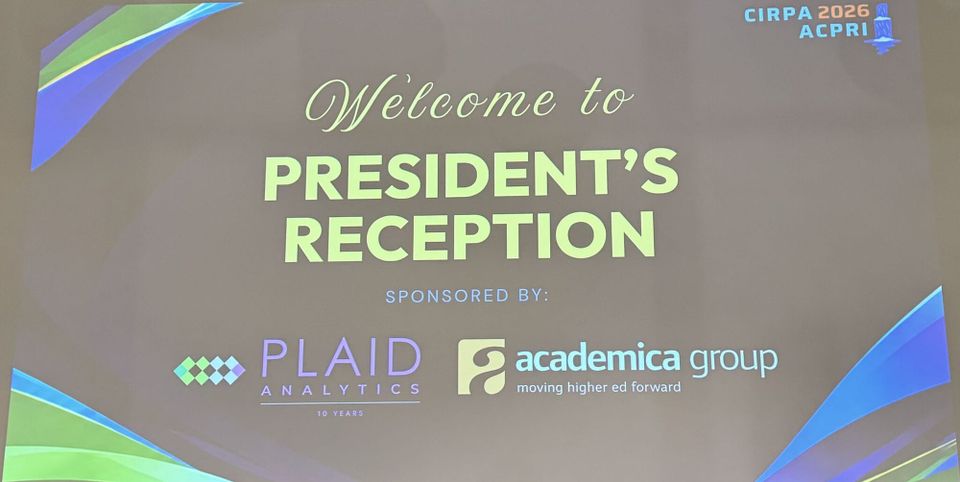
Last week I had the privilege of attending the Canadian Institutional Research and Planning Association (CIRPA) conference in Hamilton, Ontario.
This is my 7th CIRPA conference, and I can confidently say I’m still learning new things each time. To boot, I get to re-connect with wonderful colleagues from across the country, meet new ones, and share some of what I’ve learned.
Attending a conference as a vendor is a bit different than being an attendee. There are some extra logistics, like making sure your swag items arrive and your table is set up (or not, and perhaps you are overseeing the great sock hunt of 2026). In turn, you need to work harder to attend presentations than might otherwise be the case. As a result, a lot of your conference learning comes from conversations with attendees and the presentations you are actively a part of.
A few themes jumped out to me from this year’s conference:
- Program costing was everywhere. Large institutions, small institutions, research universities, polytechnics, and everyone in between seems to be actively building or exploring the idea of program costing. Of course, as Andy Hu from Queen’s University noted, it’s always far more than just program costing: sure, it tries to assign costs to programs, but also to courses, and it almost always includes the revenue side as well. Those of us from an analytics background are very familiar with the idea that the question you’re asked is usually not the question that actually needs answering, and the skills IR professionals bring to this space help uncover the true need and enable them to build more appropriate data solutions. I wrote more on this after Re:University.
- Human Resources analytics was more prevalent than I was expecting. This year I co-presented with Dorys Crespin-Mueller from Thompson Rivers University (TRU) on our respective HR analytics journeys. Dorys’ team at TRU is responsible for employee analytics, and my team has been working with multiple universities and colleges across North America on building analytics architecture HR teams and executives can trust. Nearly half the room said their office handled at least some aspects of HR analytics, and about a quarter suggested they think the request is coming soon. I’m looking forward to reconnecting with this community to share some more learnings with each other (stay tuned, HR analytics friends).
- AI, integrations, and automations were big topics. As with most conferences I attend, there was a mix of perspectives ranging from teams who are getting started with AI and using it for help summarizing meetings and other documents, to those building their first agents. Still others have moved further, with one person I spoke to having set up OpenClaw on a private server and making it possible to send a concept via a photo, and 10 minutes later they’ve got a full working app.
On the integrations and automations front, I’m seeing an increasing proportion of institutions leveraging platforms like Microsoft Fabric and Amazon Web Services to make their reporting and analytics lives easier, more scalable, and more governed and secure.
I didn’t think my own AI journey had carried me that far, but as I round the corner to having built four fairly large systems and dozens of smaller ones, I’m starting to realize I have a lot of knowledge to share with the community, with the first opportunity to come in conversation at the AI-cademy conference with our friends at Higher Education Strategy Associates, starting this Sunday, November 8, at the University of British Columbia in Vancouver.
Of course, no Institutional Research conference would be complete without at least a few conversations on how data definitions don’t align, and how systems don’t talk to one another. These result in your talented (and expensive) IR professionals spending their time reconciling between different reports or across systems, and trying to come to agreement on just which definition of FTE should be used for which purpose.
That’s why it was such a treat to present on the MortarCAPS higher learning data standard (MCDS) with Sandeep Sidhu from Emily Carr University. We had a strong turnout for our workshop, with colleagues from across institutions and sectors learning more about why a shared and sector-owned data standard matters, how it can help them, what goes into a standard from an institutional, provincial, and national perspective. I found our attendees brought great questions and scenarios, such as how a standard can deal with multiple and sometimes competing hierarchies within organizations, and how MCDS can complement other standards like PESC, Statistics Canada’s PSIS, and several others. If you missed it, I wrote about why a shared standard matters earlier this year.
All in all, I feel like the future of Institutional Research is bright. I suspect the era of building hundreds of dashboards and having stakeholders consume them in self-service will begin to close, and the era of analytics enabled by AI is rising, which could create immense opportunities for personalized analytics. To get there, we need to trust our data far more than today, and to build that trust we need strong guardrails, great collaboration across teams, and data governance that goes beyond documentation.
Until next time, (or maybe I'll see you at Ai-cademy soon?)
Andrew.