Spring 2026 Newsletter & Upcoming Events
It's approaching the end of the fiscal year and well into the winter/spring term for post-secondary institutions, so registrars and enrolment planners are gearing up for strategy and contingency planning sessions as high school transcripts and admission conversion numbers start rolling in. Earlier enrolment projections are being tested and teams need to prepare for collaborative, fast decision-making to bolster marketing plans or increasing their intakes.
At Plaid, we know this can be a stressful time for institutions as academic leaders as they wonder if they'll fill program seats and have enough instructors, administrative leaders look at resource availability and distribution, and institutional research prep annual accountability and government reports. That's why we've focused our next four months on creating opportunities for you to talk with us about your biggest data challenges, contingency and growth plans for your institutions future, or how to make the most of your remaining data and analytics budget before the fiscal year end.
Professional Development Workshops: Asking "What if?": Working with Scenarios in Enrolment Forecasting
A leadership masterclass designed for individuals and teams who want to learn to shift from a "once-a-year" plan to a dynamic and collaborative planning that aligns enrolment, finance, strategic planning and academic decision-making. Leaders from all areas face uncertainty, from program shifts, budget restrictions, to employee attrition, and infrastructure changes. This change can happen fast, but traditional forecasts are rigid and slow. Without a way to test "what-if" situations, it's difficult to prepare for the future.
We'll help you determine if you have the data and technology to move on from spreadsheets, if your planning culture is ready for more than annual outlook reports, and what your options are for keeping scenario development in-house, outsourcing to a forecasting consultant, or finding a middle ground that saves you time and money but keeps you in control.
All participating institutions receive a Forecasting Maturity Assessment. Institutions participating at the Leadership Team or Executive Team level also receive a one-page Customized Strategic Roadmap.
Tiered workshops available to suit your need: with individual, leadership team or executive team participation types, your investment starts at as low as $395 per person. Group rates available.
Registration is open now until February 15th. Our two-day leadership level cohorts sessions are March 3rd and 17th, or March 13th and 27th. Book the Executive Level or request other dates here.
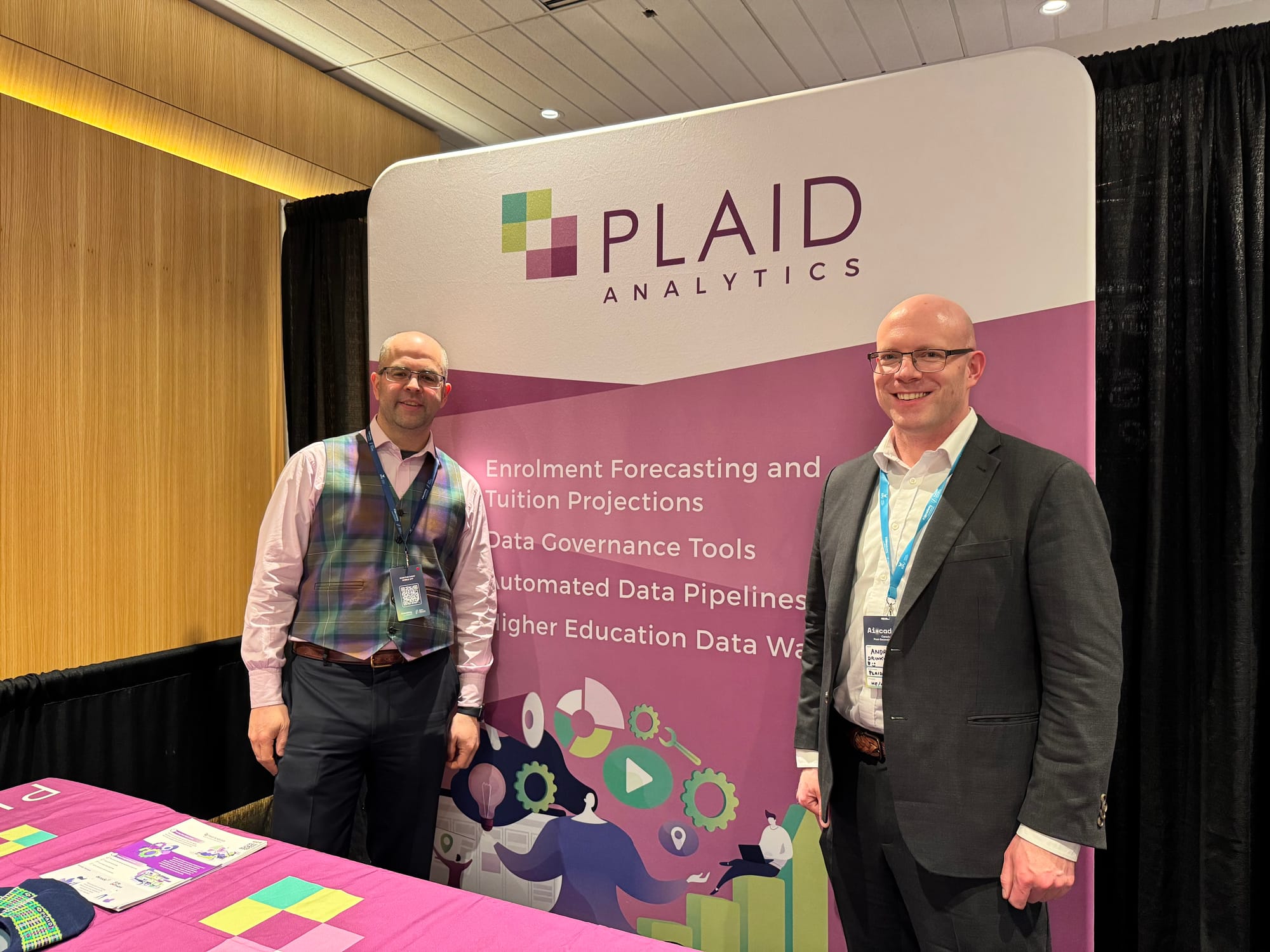
Meet Pat and Andrew at Re:University 2026 in Ottawa, January 29 to 30th.
Join Plaid co-founders for a generative discussion on What problems could Universities solve if they "just had better data"?. We'll be addressing questions like:
❓What data do we actually need, not just what we have?
❓If we were to collect new or different data, why would we do it?
❓What could we unlock if we had the right data infrastructure?
❓How do we bring institutions together to share data in ways that make sense and actually improve decision-making?
Session details:
🗓️ January 29th 3-4pm
📍Rideau Room (3rd floor), Ottawa Marriott Hotel
Between sessions we'll be at the booth in Advisory Alley on the first floor to talk with about your specific challenges, getting started with an analytics strategy, IT struggles with managing metadata and shadow spreadsheets, enrolment management, forecasting and all things data and data warehousing related.
Andrew also wrote about what he's been thinking about and where he's seen things shift in higher ed since AI-cademy last year in this new blog post.
Get Plaid on your calendar immediately.
If something in this newsletter or on our website sparked a question - about enrolment scenarios, forecasting uncertainty, data integration, governance, or how peers are approaching similar challenges - you don’t need to hunt for a contact form or start an email chain. Every page of our website now has a "Schedule a conversation" button on the bottom right corner.
With one click see Andrew's availability, choose a date, select a meeting time and have a short, exploratory conversation with him as early as tomorrow*.
These conversations are informal and practical: bring a real question, a live scenario, or something you’re wrestling with right now.
*excluding weekends
New on the Plaid Blog:
6 Keys to Power BI Success
I didn’t expect Power BI would require me to learn a whole new approach to how I work with data. In Power BI, I found my SQL knowledge wasn’t useful (instead I had to learn 2 new languages), I shouldn’t get too creative with visuals, most of my time would be spent on getting the data structure just-so, and I need to limit my expectations of exploring the data in Power BI.
After one year of working with it, here’s 6 things I wish I knew before I started my first Power BI project.
No time to read? Here's the short version:
- Stick to Power BI's core visuals. No fancy stuff.
- A Star schema data source is non-optional.
- Give your team way more time than you think they need to develop the dashboards.
- Groups should be set up on the data source side, not in Power BI.
- Sort tables are annoying to build but required for good visual design.
- Get your data governance and metadata definitions in order before you start.
Visit the blog for a 7th bonus tip on survey data:
Looking Back at AI-Cademy and Looking Ahead to Re-University
Last year, I attended the AI-Cademy conference hosted by Higher Education Strategy Associates with a mix of excitement and curiosity that probably felt familiar to many people in the room.
Artificial Intelligence was everywhere.
We were deep in the hype cycle. Institutions were experimenting, vendors were showcasing prototypes, and campus leaders were asking big questions about what AI might mean for teaching, learning, planning, and administration. There was genuine energy, and also a fair amount of uncertainty.
A year later, the conversation feels different. The idea of AI is still somewhat new, but has advanced considerably in this time. We see the rise of agentic AI, and a more thoughtful approach for where it should, and should not, be deployed.
My "aha" Moment
One of the most memorable moments for me last year came not from a technical session, but from a keynote presentation by Arizona State University.
They described how AI was...