
Are We Actually Ready for Shared Analytics Standards? A Question Worth Asking at ARUCC | PCCAT
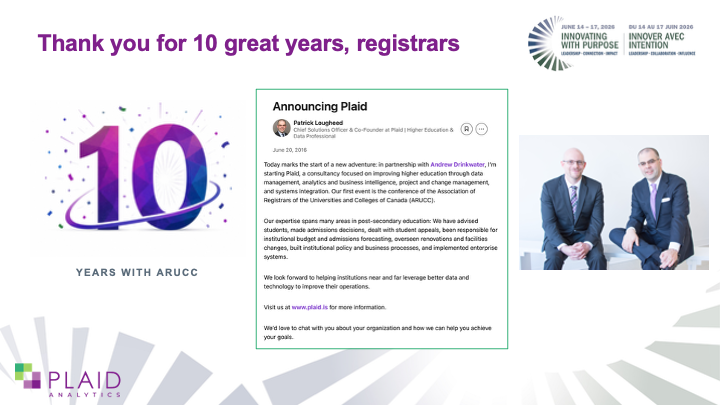
Ten years ago, we launched Plaid Analytics at the Association of Registrars of the Universities and Colleges of Canada (ARUCC) conference. So returning to Montréal this week as a sponsor feels a little like coming home - and it has me thinking about how much the conversation in this community has changed, and how much of it hasn't.
Here's what hasn't changed: most institutions still can't fully agree on what their own numbers mean.
I'm hearing more talk about shared analytics standards in Canadian higher education - frameworks like MortarCAPS or PESC that promise a common language for the metrics we all report on. It's hard to argue with the value of a framework, but the trick is usually in the implementation details. Conversations like these leave me wondering: are our institutions actually ready to adopt a shared standard, even if a good one existed tomorrow?
That's the question I want to dig into with you at our roundtable in Montréal.
Standards assume a foundation that often isn't there
As I've argued before, the standard is foundational - but the integrations, pipelines, and governance that turn it into a live, conformant figure are what brings the standard to life and makes it useful.
A good standard helps ensure consistency both within an institution and across institutions.
But I still see some gaps. While a lot of conversations about standards like MortarCAPS are rightly focusing on the interoperability components, the analytics-focused conversations seem to focus more on definitions than defensibility or risk.
The questions I find myself wanting more of are less about what a metric means and more about whether you can stand behind it:
- Can you trace a reported metric back to the system it came from?
- Does everyone who touches that metric apply the same business rules?
- When a definition changes upstream, does anyone downstream find out?
- Is the number on the board report the same number the Institutional Research (IR) office would produce if you asked them cold?
If the answer to those is "mostly, I think so," you're not alone. But "mostly, I think so" is a shaky foundation for a sector-wide standard.
Why this is hard isn't a mystery
None of this is because institutions are careless. It's because university data environments are decentralized by nature. Registrars, IR, Finance, HR, and others each solve real problems with the tools in front of them, and over twenty years of watching these environments up close, I've come to see that as a feature as much as a bug. People build what they need.
The challenge is that shared standards ask decentralized institutions to agree - not just on a definition, but on the entire path a number travels before it becomes a reported figure. That's a readiness problem before it's a standards problem.
What "ready" actually looks like
I don't think readiness means having everything documented and locked down before you can participate. That's a very high bar, and shouldn't prevent starting. To me, readiness means being honest about where you are, and having enough visibility into your own data flows that you could defend a number if a funder, an auditor, or a colleague at the next institution over asked how you built it.
A few things tend to separate institutions that are ready from those that aren't:
- They can see their real data map, not the official one. The architecture diagram says System of Record → Warehouse → Report. Reality is usually more complex.
- They treat definitions as living, not laminated. A data dictionary that was accurate two years ago is a liability if nobody's been maintaining it since.
- They've started somewhere small. Readiness isn't a transformation project. It's usually one team, one metric, traced end to end, proving the value before scaling.
If you've read our recent posts on MortarCAPS and shadow systems, this will sound familiar. Shared standards are necessary. They're also just the start.
There's a bigger point underneath all of this: readiness isn't only a technical exercise. The institutions that get the most out of a shared standard are the ones that connect it to a clear strategy - what they're trying to decide, fund, or defend with the numbers in the first place. Strategy and data are better together. It's part of why we value the work of partners like HESA, whose strategic lens on the sector complements the data readiness side we focus on. A standard without a strategy is just a more consistent way to produce numbers nobody's using.
Let's talk about it in Montréal
This is exactly the kind of question that's better debated in a room full of registrars and SEM leaders than answered in a blog post. So we're hosting a roundtable at ARUCC | PCCAT 2026:
Roundtable: Is Canadian Higher Education Ready for Shared Analytics Standards Like MortarCAPS?
This isn't a presentation — it's a working conversation among peers about what shared standards could solve, and what makes them genuinely hard to implement. If you took the self-assessment, bring your toughest "No" to the table. That's exactly what we'll be discussing.
----
Tuesday, June 16 · 2:45–3:30 PM · St-Laurent 3, Hôtel Bonaventure Montréal
It's a working conversation, not a sales pitch - a chance to compare notes with peers on what readiness actually looks like across our institutions, where the real barriers are, and what a realistic path forward might be.
Can't make the roundtable, or not at the conference this year? I'd still love to hear how your institution is thinking about this - reach out anytime and let's connect.
See you in Montréal.